
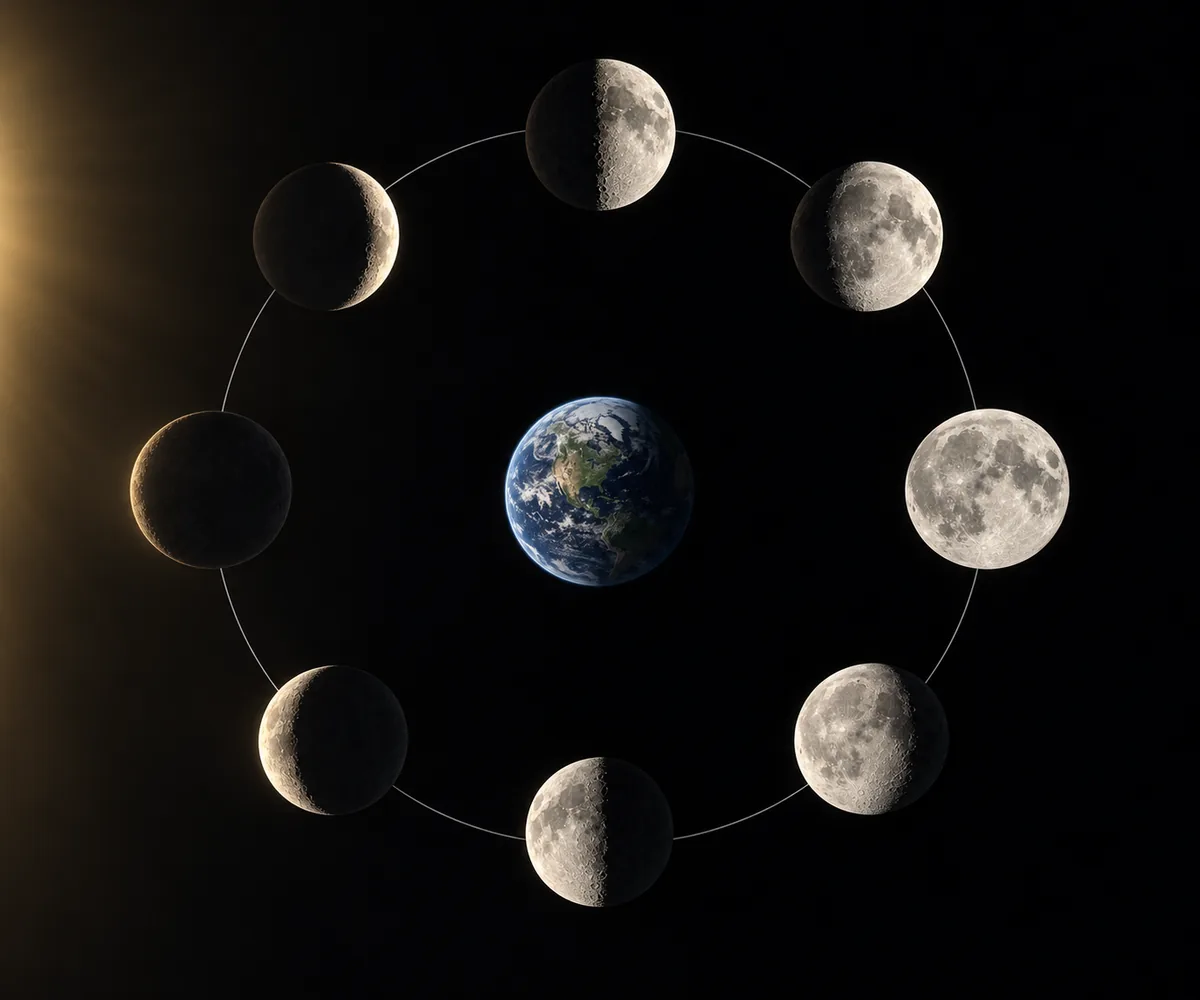
Moonrise is the calculated time when the Moon appears at the eastern horizon, while moonset is the comparable time at the western horizon. Both depend on the date and the observer’s location, so choose a city or coordinates before reading a table. Treat the thirty minutes around the listed time as a search window, then combine azimuth, altitude, clouds, and local obstructions to decide where and when to look.
Read moonrise and moonset as one answer
When you open an ephemeris or an online result, check the date, place, and time standard first. A page can show local civil time, UTC, or a time adjusted for a selected city. Once the convention is clear, use the moonrise and moonset time to decide whether your planned observation is after sunset, late at night, or before sunrise.
The two values describe events during a local calendar day, not a promise that the Moon will remain visible for the whole interval. Some locations have no moonrise or no moonset on a particular date, and a moonset can continue after midnight. A blank value or a note such as “none” should never be changed to 00:00; it represents a real boundary condition.
A naked-eye observer usually needs the rise time and direction first. A photographer may also need altitude, illumination, twilight, and nearby lights. Keep date, place, lunar phase, and time together in your notes so you can compare another city or another night without losing the assumptions behind the number.
| Display | What it means | Practical caution |
|---|---|---|
| Moonrise | A calculated horizon crossing | Hills and buildings can delay the first visible moment |
| Moonset | A calculated return to the horizon | The event may continue into the next date |
| Azimuth | A compass direction in degrees | Many tables use north 0°, east 90°, south 180° |
| Altitude | Degrees above the horizon | Low altitude is more affected by terrain and haze |
What the two times actually measure
Moonrise is calculated against an ideal horizon. Different services may use the Moon’s center, the apparent upper limb, or a convention that includes atmospheric refraction. Rounding can add another minute or two. When two reputable tables disagree slightly, compare their definition, elevation, and time zone before calling one of them wrong.
Earth’s atmosphere bends light, so the geometric horizon and the horizon seen by an observer are not identical. A clear seashore may produce a result close to the published value, while a valley or a city skyline can hide the Moon for several minutes. The safest interpretation is “start looking around this time,” rather than “the Moon must be visible at this exact second.”
Moonset follows the same logic. Near the end of the event the Moon is low, and haze or artificial light can make it disappear before the calculated time. Leave room to finish an observation and pack equipment. A rise or set prediction describes celestial geometry; it does not guarantee a clear sky or an unobstructed horizon.
Why moonrise and moonset change by city
Tokyo and Osaka are not at the same longitude, so the Moon reaches their local horizons at different clock times. Sapporo and Naha also differ in latitude, which changes the Moon’s path, maximum altitude, and the direction of the horizon crossing. A table for your home city should not be copied into a travel plan for another region.
Longitude mainly shifts the local clock time, while latitude changes how the orbit is tilted against the horizon. On one date the Moon may rise northeast, and on another it may rise southeast. Season, lunar orbital inclination, and the observer’s latitude work together, so a simple rule based only on the phase is never precise enough for a search direction.
For a useful comparison, keep the date fixed while changing the city, then keep the city fixed while changing the date. The first test shows geographic differences; the second shows the Moon’s daily movement. Record coordinates and, when relevant, elevation, because a mountain overlook has a different visible horizon from a street at sea level.
- Longitude affects the clock time of a horizon crossing.
- Latitude affects the direction and height of the Moon’s path.
- Terrain, trees, and buildings create a local horizon that the calculation may not know.
Use azimuth and altitude to find the Moon
If a table includes azimuth, translate its angle into a compass direction. In the common convention, north is 0°, east 90°, south 180°, and west 270°. An azimuth of 90° points due east; 135° points toward the southeast. Some products use a different reference, so read the legend before you step outside.
Altitude is the angle above the horizon. A Moon at five degrees can be hidden behind a row of trees or a nearby roof, and urban light makes a thin crescent harder to see at low altitude. Waiting a little after moonrise lets the Moon climb into a clearer part of the sky, although clouds may still be the deciding factor.
A phone compass can help, but calibrate it away from cars, railings, and other magnetic materials. Hold the phone so its direction matches the actual horizon. Azimuth is a reference line, not a glowing arrow in the sky; use it to choose an open sector, then search the clouds and skyline with your own eyes.
A reliable moonrise and moonset observation routine
Choose the observing place, write down the moonrise or moonset time, and note the azimuth. Reserve the thirty minutes around the event as a search window, then move to a safe location with a broad horizon. Use public access rules, keep away from traffic, and do not enter private property simply to obtain a better view.
A young waxing crescent is often searched for in the western sky after sunset, while a waning crescent is often searched for in the east before sunrise. A full Moon tends to rise around sunset, but these are patterns rather than substitutes for the day’s azimuth. If clouds are moving, watching a gap may be more useful than waiting for a single exact minute.
For photography, decide whether you want the warm color of a low Moon beside a building or a higher Moon with more stable detail. Check exposure, vibration, nearby lights, and cloud cover. Never point binoculars or a telescope at the Sun, even while waiting for the Moon. The forecast is a planning aid, not a safety or visibility guarantee.
- Confirm the date, location, and time standard.
- Set aside the thirty minutes around the listed event.
- Use azimuth to choose an open direction, then check the skyline.
- Treat cloud, haze, artificial light, and personal safety as separate decisions.
Connect moonrise and moonset with lunar phase
Lunar phase gives a broad clue about the part of the day when the Moon is likely to be visible. A thin waxing crescent stays near the Sun and is often found low in the west after sunset. A full Moon is opposite the Sun and commonly rises near sunset. A waning half Moon is usually easier to find from late night into the morning.
These are average patterns, not a timetable. Moonrise and moonset move each day, and the path changes with season and latitude. Do not derive an exact local time from illumination or lunar age alone. Use the phase calendar to understand the trend, then use a location-specific rise and set table for the actual observation.
Compare three to seven nearby dates to see the movement clearly. A rise can shift later, and a set can cross midnight into the next date. New Moon, first quarter, full Moon, and last quarter are event moments; the Moon may be below your horizon at the exact moment. Keep event time and visible time as separate notes.
No-rise days, uncertainty, and public data sources
A Moon can be above the mathematical horizon and still invisible through thick cloud, haze, mountains, buildings, or city glow. Refraction can also make the apparent event differ by a few minutes. Describe a prediction as a search guide, never as proof that the Moon will be visible. A clear result and a clear sky are different conditions.
At high latitudes, a date may have no moonrise or no moonset. Even in Japan, a set can occur after midnight or a result can cross the civil-date boundary. When a value is missing, check the note and compare a nearby date or city instead of forcing a zero time into the plan.
The National Astronomical Observatory of Japan publishes tables with rise, azimuth, transit, altitude, set, and lunar age for Japanese locations. The USNO One Day service is useful for cross-checking a chosen location and date. When numbers differ, compare time zone, horizon, elevation, refraction, and rounding before choosing a source.
- Record the source date and the observing coordinates.
- Check definitions before treating a small difference as an error.
- Keep weather and safe access separate from astronomical geometry.
Moonrise and moonset FAQ
Will I definitely see the Moon at the moonrise time?
No. The value normally uses an ideal horizon. Clouds, haze, terrain, buildings, and light pollution can hide the Moon, so search during the surrounding thirty minutes in the predicted direction.
How much does moonrise change each day?
It often becomes later from one day to the next, but the shift is not a fixed fifty minutes. Latitude, date, and the Moon’s orbit change the amount, so use a local daily table.
Can I use Tokyo’s moonrise time in Osaka?
Do not copy it as a precise value. Different longitude and latitude change the time, azimuth, and altitude. Select Osaka or enter its coordinates and calculate again.
What direction is azimuth 90 degrees?
In the common convention with north at 0° and east at 90°, it is due east. Check the table legend and keep a phone compass away from magnetic metal.
What should I do when a table says there is no moonrise?
Do not turn the blank into 00:00. Read the note, then test a nearby date or a nearby city to find a condition where the Moon actually crosses the local horizon.
Can a lunar phase calendar give the exact moonrise time?
No. Phase describes the illuminated shape and cycle. Moonrise and moonset require the date and observing location, so use the calendar with a location-specific ephemeris.
Public reference data
- National Astronomical Observatory of Japan: Moonrise and moonset in TokyoA daily public table with rise, direction, transit, altitude, set, and lunar age.
- USNO: Complete Sun and Moon Data for One DayA source for checking solar and lunar events at a chosen place and date.
- How Moon phases workA site guide to lunar phase, lunar age, and the changing shape seen from Earth.