
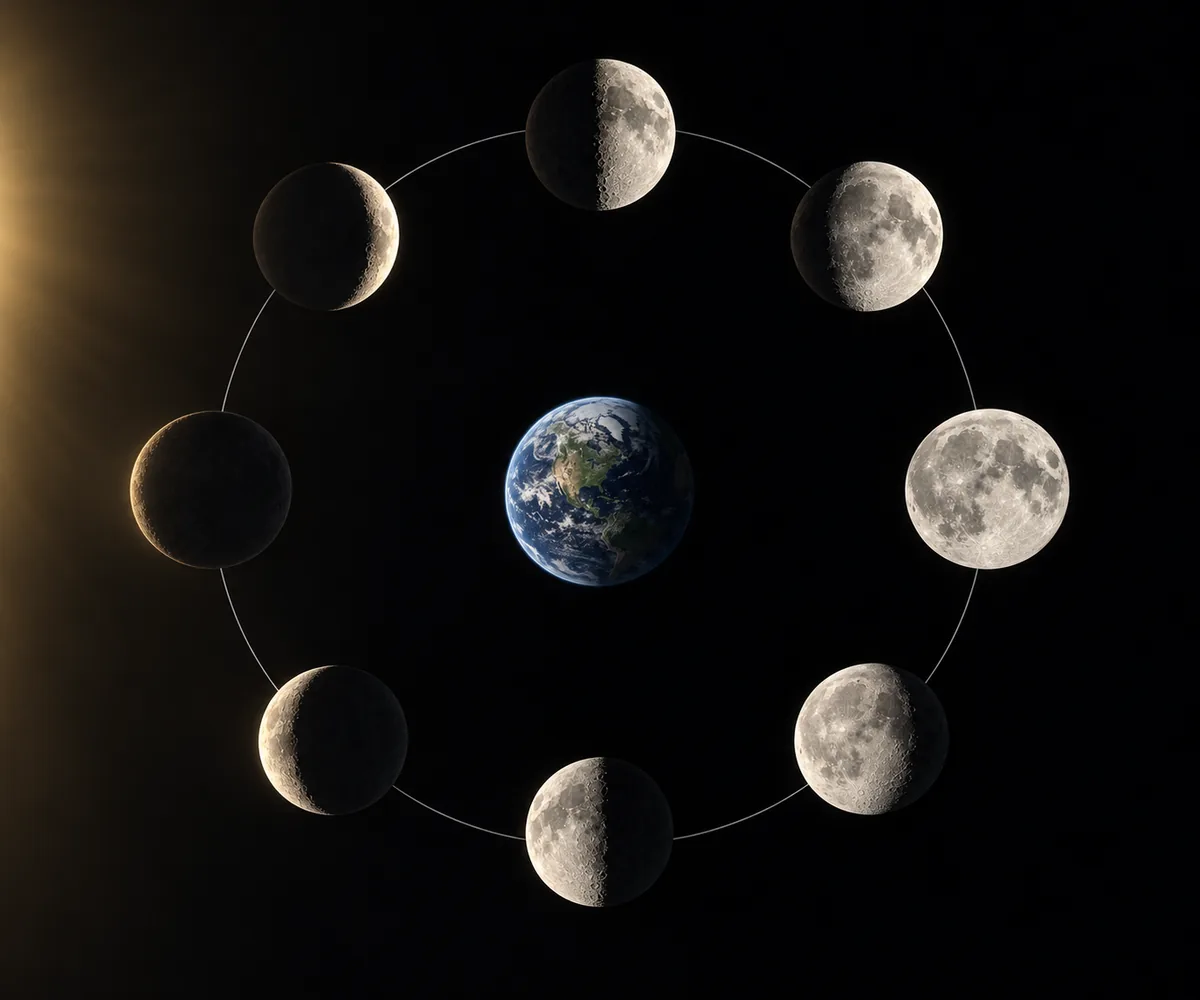
Moon phases happen because the Moon reflects sunlight while orbiting Earth. The Sun always lights roughly half of the Moon, but the angle between the Sun, Earth, and Moon changes. From Earth we see different portions of that bright half, producing the familiar sequence from new Moon through crescent, quarter, gibbous, full Moon, and back again.
Moon phases: the lit portion changes, not the Moon’s shape
The Moon does not produce its own visible light. Sunlight reaches one hemisphere while the opposite hemisphere is in night. About half of the lunar surface is therefore illuminated at any moment. What changes during the month is our viewing angle: from Earth we may look toward the bright side, across its edge, or mostly toward the dark side.
Moon phases describe that changing view. The Moon keeps the same shape; as it orbits, we see a different fraction of its sunlit half.
How the Sun, Earth, and Moon create moon phases
The Moon moves eastward along its orbit around Earth. When it appears close to the Sun in the sky, its sunlit hemisphere faces mostly away from us. This is the new Moon phase, when the Moon is usually difficult to see at night. As the Moon moves farther from the Sun’s direction, more of its illuminated side turns toward Earth and the visible bright area grows.
Near the point opposite the Sun, we see almost the full bright hemisphere: full Moon. The lit area then shrinks through the waning phases. The eight names mark continuous change, not fixed shapes.
The eight moon phases in order
The cycle is often described as waxing while the illuminated portion grows and waning while it shrinks. A complete sequence begins at new Moon, reaches full Moon, and returns to new Moon. The names below describe common appearances from the Northern Hemisphere; the orientation of the bright side looks different in the Southern Hemisphere.
A synodic month, from one new Moon to the next, averages about 29.53 days. The lunar ages in the table are approximate because the exact phase occurs at a specific time, not at midnight on a calendar date. Use the phase name as a visual guide rather than treating the age ranges as strict boundaries.
| Order | Phase | What it looks like | Typical viewing window |
|---|---|---|---|
| 1 | New Moon | The bright side is turned mostly away from Earth | Near the Sun; difficult to see at night |
| 2 | Waxing Crescent | A thin right-hand arc is growing | After sunset in the western sky |
| 3 | First Quarter | About half of the disk is bright | Afternoon and evening |
| 4 | Waxing Gibbous | More than half is bright and still growing | Evening into night |
| 5 | Full Moon | The visible disk looks nearly round and bright | Rises around sunset |
| 6 | Waning Gibbous | The bright area is shrinking after full Moon | Late night through morning |
| 7 | Third Quarter | About half of the disk remains bright | After midnight and in the morning |
| 8 | Waning Crescent | A narrow arc remains before new Moon | Before sunrise in the eastern sky |
Waxing and waning: tell whether the bright area is growing
Waxing means that the illuminated portion is increasing from night to night; waning means it is decreasing. In the Northern Hemisphere, a Moon viewed toward the southern sky generally has its right side lit while waxing and its left side lit while waning. This is a helpful cue in many familiar views, but the Moon’s apparent orientation rotates as it moves across the sky.
Use the time and direction as well as the bright edge. A thin Moon low in the west after sunset is usually a young waxing crescent. A thin Moon seen in the east before sunrise is often a waning crescent. If you are unsure, sketch or photograph the Moon from the same location on two different days. The change in illuminated area makes the direction of the cycle easier to see.
Moon phases, lunar age, and orbital period are different measures
Lunar age is the elapsed time since the most recent new Moon, usually shown in days. A Moon near age seven is often close to first quarter, and one near age fifteen is often near full Moon, but age and phase are not synonyms. Age is a time measurement; phase describes the shape of the illuminated portion as seen from Earth. The displayed value can also vary slightly with the chosen time zone and calculation convention.
The Moon takes about 27.3 days to orbit Earth relative to distant stars. A full cycle of moon phases takes about 29.53 days. Earth moves around the Sun while the Moon completes its orbit, so the Moon must travel a little farther before it lines up with the Sun in the same way again. This is why the phase cycle is longer than the sidereal orbital period.
Why moonrise shifts later through the month
From a given location, moonrise occurs about 50 minutes later each day on average. That is a useful estimate, not a fixed daily rule. The Moon’s tilted, slightly elliptical orbit and the observer’s latitude change the amount of shift. The rising direction and height above the horizon also vary with location and season.
A new Moon is near the Sun’s direction and is generally above the horizon during the daytime. A young crescent appears after sunset, first quarter is often visible during the afternoon and evening, and a full Moon rises around sunset because it is opposite the Sun. A third-quarter Moon commonly rises around midnight and can remain visible in the morning. These are broad patterns; a local horizon, hills, buildings, and weather affect what you can actually see.
The terminator is a useful guide to lunar craters
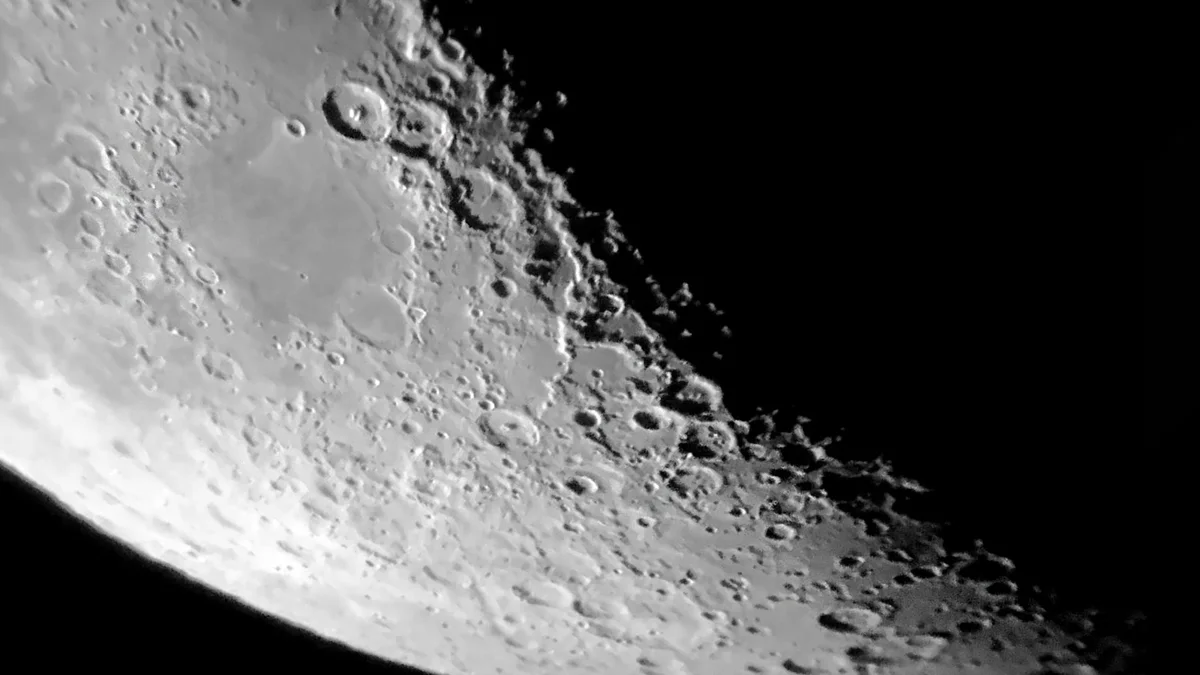
The line separating lunar day from lunar night is called the terminator. Near this line, sunlight arrives at a low angle and casts long shadows from crater rims and mountains. Those shadows make relief easier to notice than it is near the center of a full Moon, where sunlight falls more directly. A small pair of binoculars can reveal more surface depth when you follow the boundary slowly.
A full Moon is bright and easy to recognize with the naked eye, but it is not always the best time to inspect small surface features. First quarter, third quarter, and the days around them often provide stronger shadows along the terminator. The best phase depends on what you want to observe: a bright round disk, a thin crescent, or the texture of cratered terrain.
A lunar eclipse is not the same as a Moon phase
Moon phases repeat every month because our viewing angle changes as the Moon orbits Earth. A lunar eclipse happens when the Moon passes through Earth’s shadow, which can occur only near full Moon. A solar eclipse can occur near new Moon when the Moon passes between Earth and the Sun. The phase alone does not mean an eclipse is about to happen.
The Moon’s orbit is tilted by about five degrees relative to Earth’s orbit around the Sun. Most months, the Moon passes a little above or below the alignment needed for an eclipse. An eclipse requires the Sun, Earth, and Moon to line up near the points where the two orbital planes cross. To plan an eclipse observation, check a date and visibility map for your location separately from a moon-phase calendar.
A simple routine for observing the phases
Check the phase and moonrise for your location; buildings, trees, and hills can still block the view.
Record the date, time, and direction over several evenings. Never point an optical instrument at the Sun.
Clouds and local obstructions affect visibility, not the phase. Rise times are guidance, not a promise.
Common misconceptions about moon phases
Ordinary phases are not caused by Earth’s shadow; lunar age is elapsed time, not a phase name; and first quarter does not mean only one quarter is lit. The Moon is a sphere with a sunlit side, and we see a changing portion as it moves.
Earth’s shadow reaches the Moon only during a lunar eclipse. First and third quarter describe points roughly one quarter and three quarters through the cycle, when about half the visible disk is lit.
- The Moon keeps its shape; the visible fraction of its sunlit hemisphere changes.
- Lunar age measures elapsed time, while a phase describes the Moon’s appearance from Earth.
- A lunar eclipse requires a separate alignment and does not happen at every full Moon.
Frequently asked questions about moon phases
Why does the Moon look different from one night to the next?
The Moon moves around Earth, changing its angle relative to the Sun and Earth. Sunlight still illuminates about half of the Moon, but we see a changing fraction of that bright half.
Is a new Moon hidden in Earth’s shadow?
Usually not. At new Moon, the Moon is near the Sun’s direction and its illuminated side faces mostly away from Earth. Earth’s shadow is involved only during a lunar eclipse.
Does first quarter mean that one quarter of the Moon is lit?
No. First quarter is a point about one quarter of the way through the phase cycle, and the visible disk is roughly half illuminated. Third quarter has a similar half-lit appearance later in the cycle.
Does lunar age 15 always mean a full Moon?
No. Lunar age is elapsed time since new Moon, while full Moon is an exact alignment in the Sun-Earth-Moon geometry. The two are close on average but do not match exactly on every date.
Why are craters easier to see near a quarter Moon?
Sunlight reaches the Moon at a low angle near the terminator, creating long shadows around crater rims and mountains. Those shadows make surface relief stand out.
Do Moon phases look the same everywhere on Earth?
The phase cycle is shared around the world, but the Moon’s orientation, rise time, and visible path depend on location and time. The bright side also appears oriented differently from the Southern Hemisphere.
Sources
- NASA Science: Moon PhasesReference for the eight phases and the roughly 29.5-day cycle.
- Study-Style: Moon phases and lunar ageJapanese-language reference distinguishing lunar age and phase periods.
- Hitachi Kids: Observing the Moon’s phasesJapanese-language beginner reference for the changing Moon.
- Star Walk: Moon CalendarReference for an existing Moon image used on this site.