
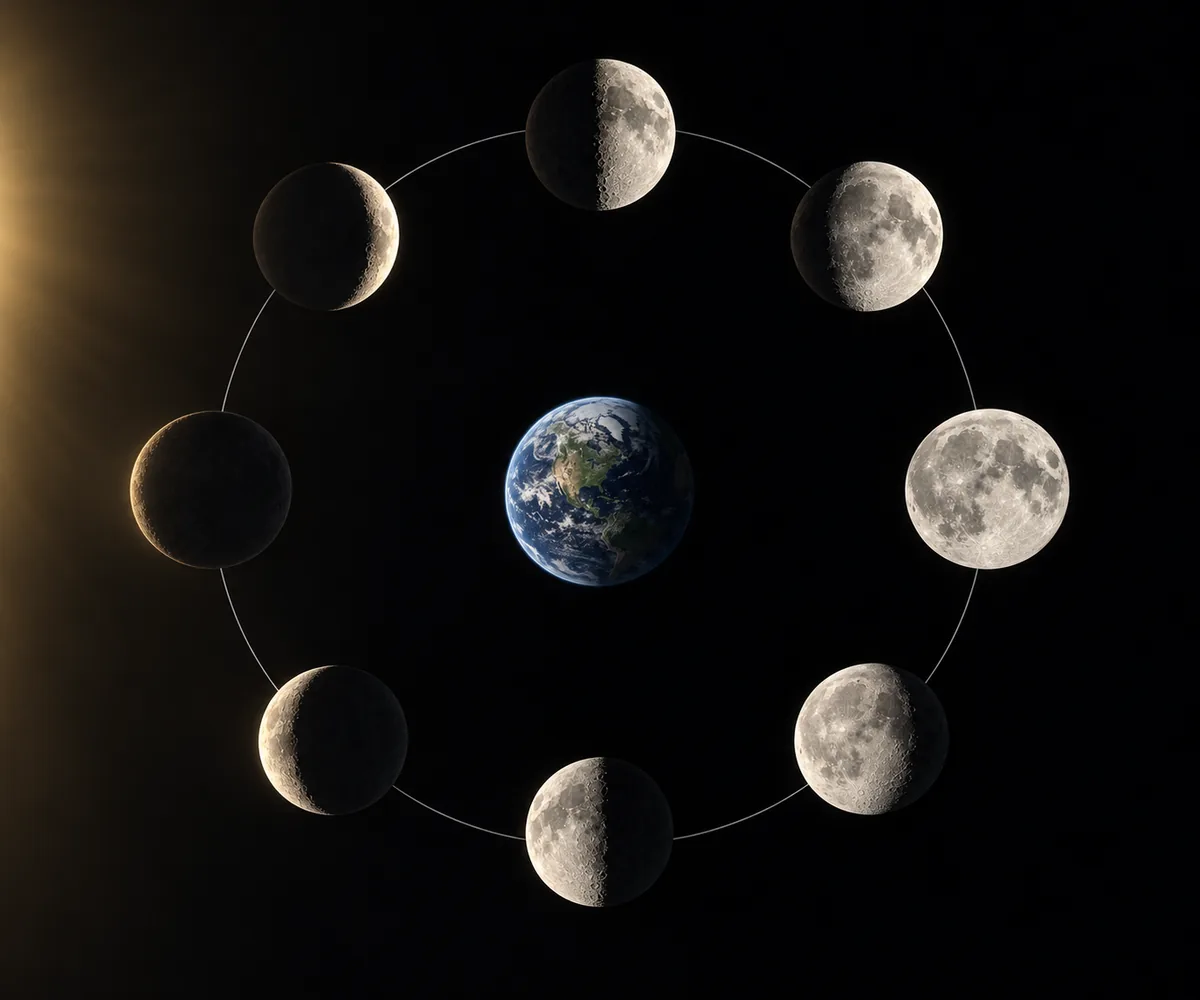
Today's Moon phase describes the illuminated shape seen from Earth, while lunar age is the time elapsed since the latest new Moon. Moonrise and moonset depend on the selected place, so use a city or location before planning an observation. A thin waxing crescent is often searched for in the western sky after sunset; a thin waning crescent is commonly found in the east before sunrise. Combining phase, time, direction, and weather gives a more useful answer than any single number.
What to read first on a today's Moon result
Start by checking the date, selected city, and time zone. Then read the phase name, illumination percentage, and lunar age. A few percent illumination usually means a very thin crescent, about half illumination is near first or third quarter, and nearly one hundred percent is close to full Moon. These labels describe a changing cycle rather than eight hard visual steps, so the exact appearance can fall between familiar names.
Lunar age counts time from the instant of new Moon. An age near seven days is often close to first quarter and an age near fifteen days is often close to full Moon, but the values are not interchangeable. The displayed decimal can vary with the observation time, rounding convention, and time zone. Read the number as a useful reference, then use the phase image and rise or set time to decide what you can actually see.
Your purpose changes which value matters most. A naked-eye observer needs a rise time, a broad direction, and a clear horizon. A photographer also needs altitude, local light, cloud cover, and a stable camera position. Treat date, place, and phase as one group so that a result from one city is not accidentally used for another.
| Value | What it describes | How to use it |
|---|---|---|
| Phase | The shape of the bright portion | Check whether it is waxing or waning |
| Lunar age | Elapsed days since new Moon | Use as a time reference, not a phase name |
| Illumination | Share of the visible disk that is bright | Low values are easily lost in bright sky |
| Moonrise / moonset | Calculated horizon crossing at a place | Buildings and hills can delay the first visible moment |
Today's Moon phase and lunar age are different measurements
The Moon does not make its own light. Sunlight illuminates roughly half of its surface at any moment, and the Moon's orbit changes the angle from which Earth sees that bright half. The normal cycle of crescents, quarters, gibbous phases, and full Moon is therefore a change in viewing geometry. It is not the Earth's shadow cutting pieces out of the Moon; Earth's shadow is involved during a lunar eclipse.
After new Moon, a waxing crescent is usually found after sunset. First quarter is commonly visible from afternoon into evening, and a full Moon is near the opposite direction from the Sun and tends to rise around sunset. After full Moon, the lit area shrinks through waning gibbous, third quarter, and a waning crescent before the next new Moon. Local horizon and season can shift the practical viewing window.
The bright edge may appear on different sides when the Moon is low, when the observer faces a different direction, or when comparing northern and southern hemispheres. Do not identify waxing or waning from a saved photograph alone. Observe the same place on several dates and record whether the bright area grows or shrinks.
Why moonrise and moonset change by city
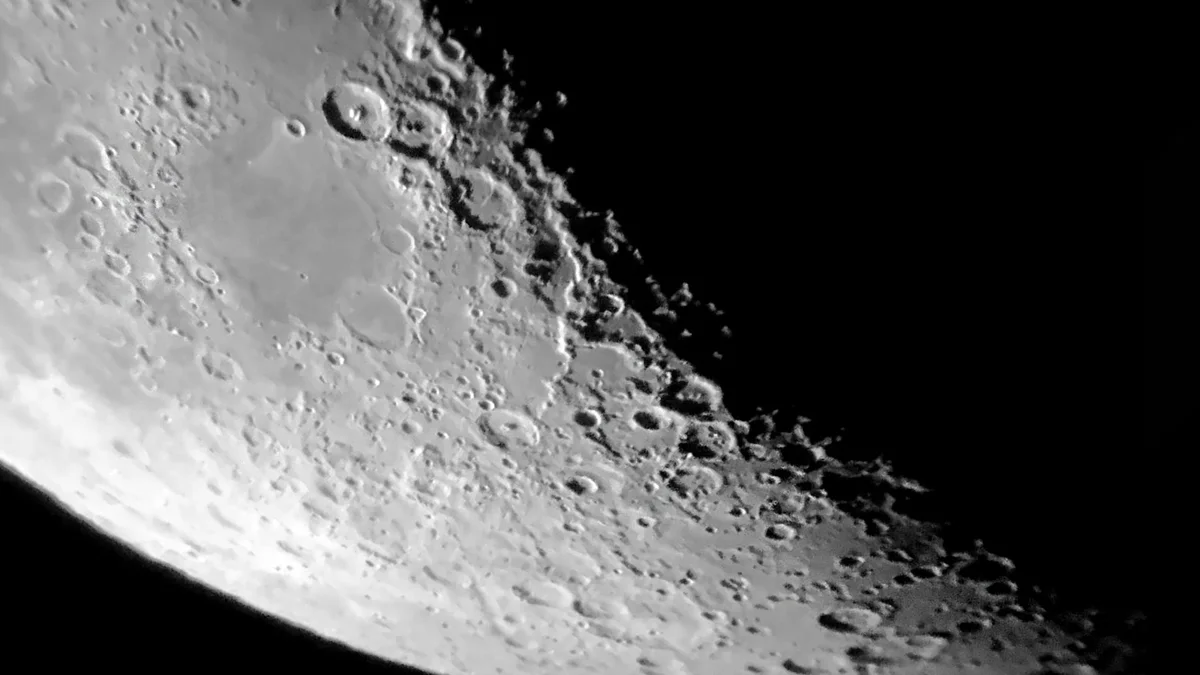
Moonrise is the calculated time when the Moon's center crosses an ideal horizon. Longitude shifts the clock time between cities, while latitude changes the path, direction, and maximum altitude. A rise time for Tokyo cannot be copied to Osaka or Sapporo. Hills, trees, and tall buildings create a second, local horizon, so the Moon may not enter your view until several minutes after the listed time.
Phase gives a helpful broad pattern. A young waxing crescent is often low in the west after sunset, full Moon is commonly near the eastern horizon around sunset, and a waning crescent is often visible in the east before sunrise. These are averages, not substitutes for a location-specific result. Use the listed azimuth and altitude when a compass or sky map is available.
Some dates and locations have no moonrise or no moonset during the local calendar day. An empty value must not be changed to 00:00. If the calculation says the Moon does not rise at that place on that date, try a nearby city or another date and keep the explanation visible so a missing event is not mistaken for an error.
A simple way to find today's Moon tonight
First select the city and date, then note moonrise and moonset. Use the thirty minutes around the calculated time as a search window rather than waiting for one exact second. Next choose an open horizon in the predicted direction. If the altitude is low, buildings and trees can hide the Moon; wait a little and check whether it climbs into view. A compass can turn an azimuth such as 110 degrees into a practical southeast search direction.
The Moon can look unusually large or orange near the horizon. The size effect is mainly a visual comparison with buildings and mountains, while the color is affected by the atmosphere. The Moon has not physically expanded. Higher in the sky it may look whiter, but a thin crescent can still disappear in twilight or urban light. Choose the time that fits your goal instead of assuming full Moon is always best.
For photography, note clouds, exposure, vibration, and nearby lights as well as phase. Never point binoculars or a telescope at the Sun, even when you are waiting for a daytime Moon. Keep a safe stance and obey local access rules. A rise prediction describes celestial geometry; it does not guarantee a visible Moon.
Compare today's Moon with a lunar calendar
A single date can make it hard to tell whether the bright area is growing or shrinking. Open the lunar calendar for three to seven nearby dates and compare illumination and lunar age. A steady increase usually marks the path from new Moon toward full Moon; a steady decrease marks the return toward new Moon. Seeing the sequence makes similar-looking crescents much easier to distinguish.
Calendar event times identify the moment of new Moon, first quarter, full Moon, or third quarter. The Moon may be below the horizon at that exact moment in your city. For an observation plan, read the event time and the local rise or set time separately, then choose the interval when the Moon is both above the horizon and accessible from your location.
Keep the city fixed when studying the phase cycle. Change the city only when you want to understand regional differences in time and direction. A saved note with date, place, phase, weather, and what you actually saw is more useful for future planning than a search snippet that omits the location.
Weather, horizon, and privacy limits
Correct phase and rise time cannot overcome thick cloud, rain, fog, dust, or strong light pollution. Astronomical calculations describe the positions of the Sun and Moon; they do not promise cloud-free conditions. Check a separate weather source, and if weather data is unavailable, say that visibility cannot be judged rather than presenting a sunny conclusion.
Thin crescents have a short window against a bright sky, while full Moon is easy to recognize but can blend into lit city surroundings. Choose a place with an open horizon and follow local safety rules. Do not enter restricted land just to reach a lower horizon. If the Moon is hidden, the calculation can still be correct; the obstruction is an observation condition, not a phase error.
You do not need to publish a precise home address to share a Moon result. A city name or broad observing area is usually enough. If a site offers browser location, refusal should leave a manual city choice available. Read the site's data policy to understand whether coordinates are calculated locally or sent to a server, and remove location metadata from photos before sharing them.
Common mistakes when reading today's Moon
It is not accurate to say that lunar age fifteen always equals full Moon, that an unseen Moon must be a new Moon, or that every unusual-looking Moon is an eclipse. Full and new Moon are alignments of the Sun, Earth, and Moon. A lunar eclipse needs an additional alignment with Earth's shadow, and ordinary phases repeat every month without an eclipse.
The listed rise time uses an ideal horizon. Give it a margin, scan the predicted sector, and remember that terrain and buildings can delay the first visible moment.
Frequently asked questions about today's Moon
How is lunar age today calculated?
It is the elapsed time in days from the latest new Moon to the selected observation time. Rounding and time-zone conventions can change the decimal slightly.
What time can I see today's Moon?
Use the moonrise and moonset for your selected city. Look around those times in the predicted direction, and allow extra time if hills, trees, or buildings block the ideal horizon.
Why is the Moon invisible at the listed time?
Cloud, haze, light pollution, local obstructions, and the difference between an ideal and real horizon can hide it. A calculated time is a search guide, not a visibility guarantee.
Are lunar age and Moon phase the same thing?
No. Lunar age measures elapsed time since new Moon; phase describes the illuminated shape seen from Earth. They are related but not identical.
Which direction should I search for a thin crescent?
A young waxing crescent is often in the west after sunset, while a waning crescent is often in the east before sunrise. Use the location-specific direction for the final answer.
Can I check today's Moon without sharing my location?
Yes. Choose a city manually. You can compare Moon phase and rise or set times without providing an exact home address or granting browser location access.
Sources
- NASA Science: Moon PhasesBackground on sunlight, viewing geometry, and the lunar cycle.
- USNO: Complete Sun and Moon Data for One DayPublic rise, set, and position data.
- MoonCalendar.wiki Moon Phases GuideA companion explanation of phase mechanics, lunar age, and observation.